
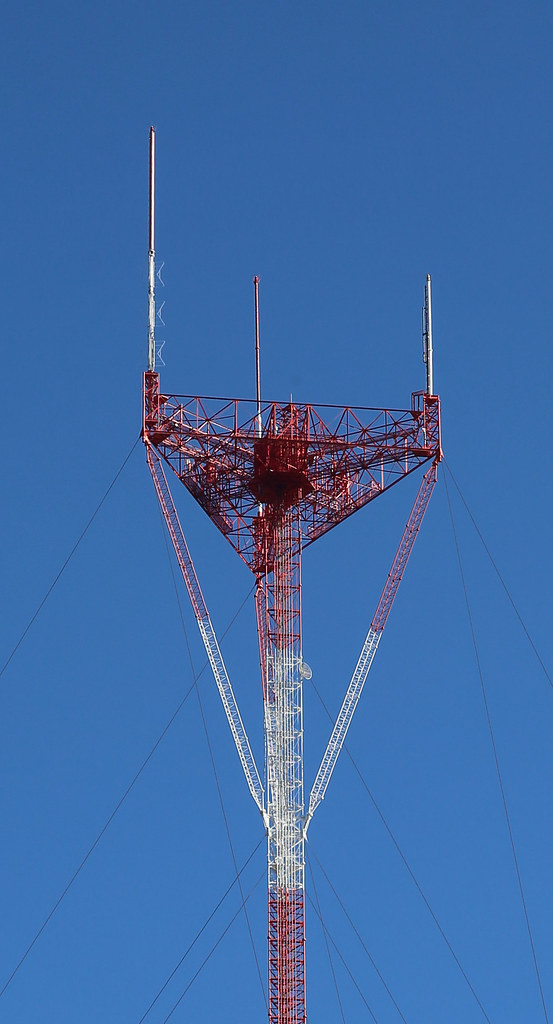
The red and white “Walnut Grove Tower” or “Transtower” was built for several Sacramento TV stations. It was built in 1961. I took this photo in 2019.
Stainless is folding. This is a matter of quiet but extreme significance for TV and FM broadcasting. This is because, to source the About page on the Stainless website, the company has—
- Constructed over 50% of the tall towers standing in the United States today
- Installed over 50% of the TV broadcast antennas on air during the analog-to-digital conversion (1996-2006)
- Designed and built more 2,000-ft towers than all other companies combined
- Pioneered industry-leading safety and training programs, like NATE STAR and NWSA.
Stainless was already in trouble when its assets were acquired by FDH in 2015. By then all the biggest had already been built, and demand for new ones was between small and nil. The situation is surely far worse now.
Broadcasters everywhere are losing viewing and listening shares to Internet files and streams. Live broadcasting is largely sidelined. Do you still use a radio other than the one in your car? Or at all?
Do you watch over-the-air TV from an antenna? Can you get stations from more than a couple dozen miles away?
TV’s digital transition in 2008 gave us better pictures but worse range for signals. “Repacks” of signals on different channels after spectrum auctions made things worse by forcing viewers to have their TVs re-scan for signals, some of which couldn’t be found. On top of that, all new TVs today come equipped to spy on on viewers, and are designed to discourage watching over-the-air TV. (Our TCL Roku TV now demotes over-the-air station listings to hard-to-find locations amidst hundreds of junk “channels” in its guide.)
To be fair, some over-the-air viewing persists. Consumer Reports says,
…about 20 percent of U.S. households with internet access now use a TV antenna, according to research firm Parks Associates.
That number is likely to rise over the next 12 months, as a new over-the-air standard, called ATSC 3.0 or NextGen TV, rolls out. Right now, these signals are available in about 80 percent of the country. The technology promises greater reliability, higher-quality video with high dynamic range (HDR), better sound, and even some new interactive features, including internet content that’s carried alongside traditional TV broadcasts.
We are one of those households. Here in Bloomington, Indiana, an indoor antenna will only get the PBS station (WTIU/30). Most of the other TV network stations (ABC, NBC, CBS, Fox, etc.) come from the antenna farm on the far side of Indianapolis, close to 60 miles away. To get those, I’m going to some trouble to get those signals, from transmitters almost 60 miles away in Indianapolis. For that I built this DAT BOSS MIX LR antenna High-VHF/UHF (Repack Ready) antenna and tested it in the upstairs future bedroom of a house we’re building in Bloomington that happens to enjoy a hillside view in the direction of Indianapolis, which made me optimistic enough about signal prospects to risk spending almost $200 on the antenna. The hard get here was the farthest transmitter: WTHR/13 (which I visited in August). As you can see, I was able to get it, along with all the other full-size stations up there, including the ones that started transmitting ATSC 3.0 signals three years ago:

My home-built TV antenna and a test TV I bought for $35 at a Salvation Army thrift store. For test purposes, it did the job. The antenna will be installed on a pole outside to the right of the sliding doors through which the antenna is looking at Indianapolis.
Still, what you can get on your phone and computer over the Internet has a zillion-to-few advantage over what you can get over the air from broadcast TV and radio stations.
Thirteen years ago, my teenage son asked me what the point of “range” and “coverage” was for radio, when every source was also on the Internet, which you could get nearly everywhere. When I started to explain the point to him, he interrupted me with three words: “Radio is dead.”
So is over-the-air television. It’s a dead tech standing. What’s walking are companies like FDH. And their direction is away.
1 response so far ↓
Re-reading Material – Doc Searls Weblog // May 4th 2025 at 12:04 pm
[…] the once mighty fall (about WMAL, above, in 2020)A look at broadcast history happening (2023)The Tall Tower Market Collapses (2024)Radio's Death Knells […]
Leave a Comment