
There have been ways other than farming for farmers to make money with their land. In the last century, the first was broadcasting. With AM radio, the transmitting antennas have typically been whole towers, plus ground systems of buried copper straps that stretch out to radii as wide as the towers are high. FM and TV have small antennas, mounted on towers if mountains or skyscrapers aren’t available. Farmers can lease use of land for any of those. For a century, lots of farmers have been doing exactly that.
In recent years, the new ways for farmers to make extra money has been by hosting wind farms or selling land for future shipping and data centers. I’ll be writing more about those later, but first I want to visit broadcasting in its golden age of tower construction, with my mind on the history of how these sites developed.
Here is an ad in the November 14, 1949 issue of Broadcasting:

Truscon is the Youngstown-based company that built (or supplied steel) for countless AM stations in radio’s golden age. The image in that ad shows an array of the six 400-foot tall self-supporting towers that transmitted the directional night signal for WFMJ, now WNIO/1390. (A big hat tip for scanning and publishing that page goes to David Gleason, who gives us the amazing and valuable World Radio History site (https://worldradiohistory.com/)
Next is a Google StreetView of what I think is the current view of the same site, with the transmitter shack and the six towers replaced. One of those is also a tower in WKBN/570’s own directional nighttime array. (In the distance is another tower not in either station’s system.)

And next is a Bing Birds Eye (a fixed-wing aircraft) view of the whole site:
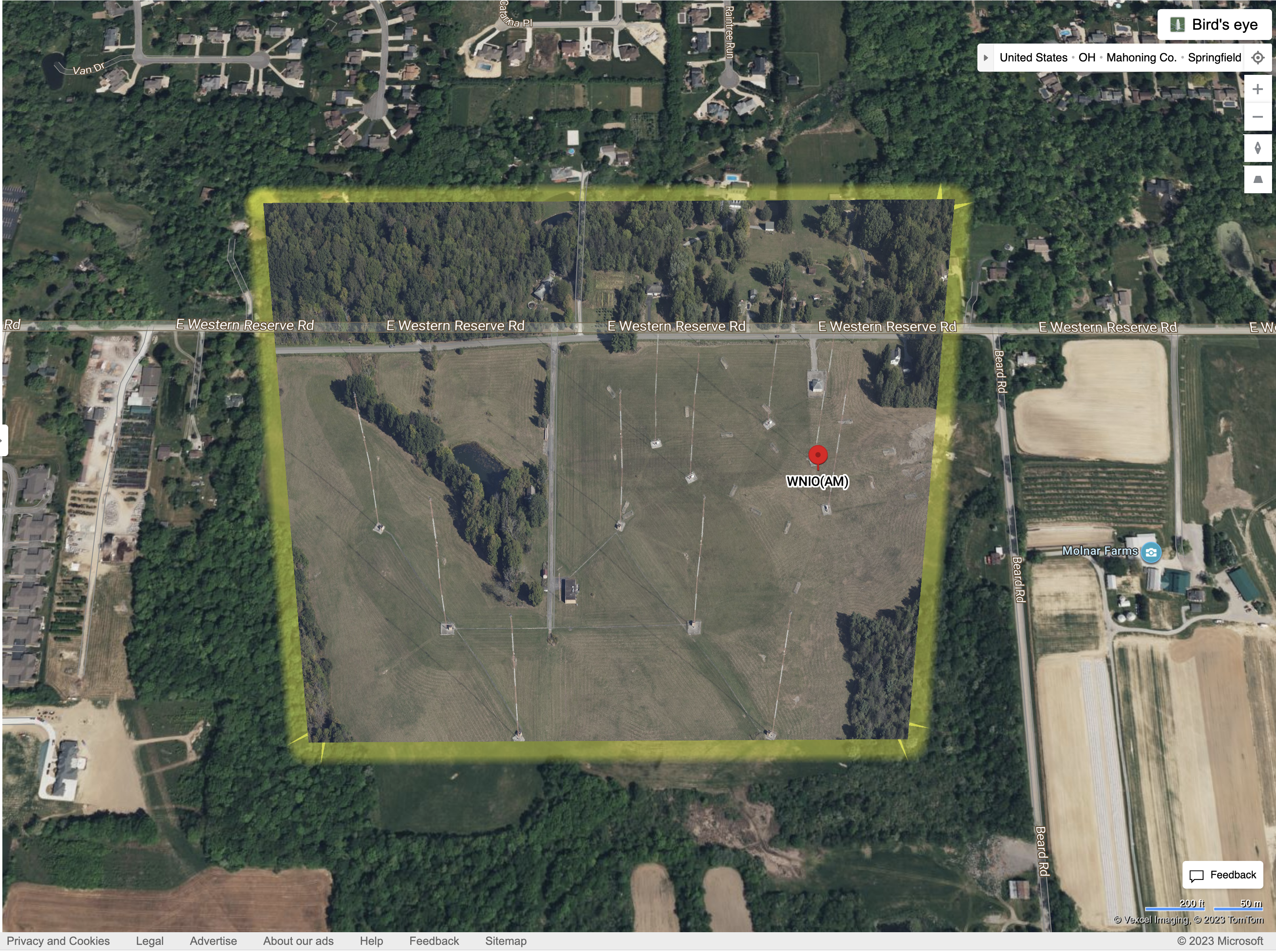
(Alas, Microsoft has killed off the Birds Eye feature on Bing Maps.)
And here is the Google view from space of the same:
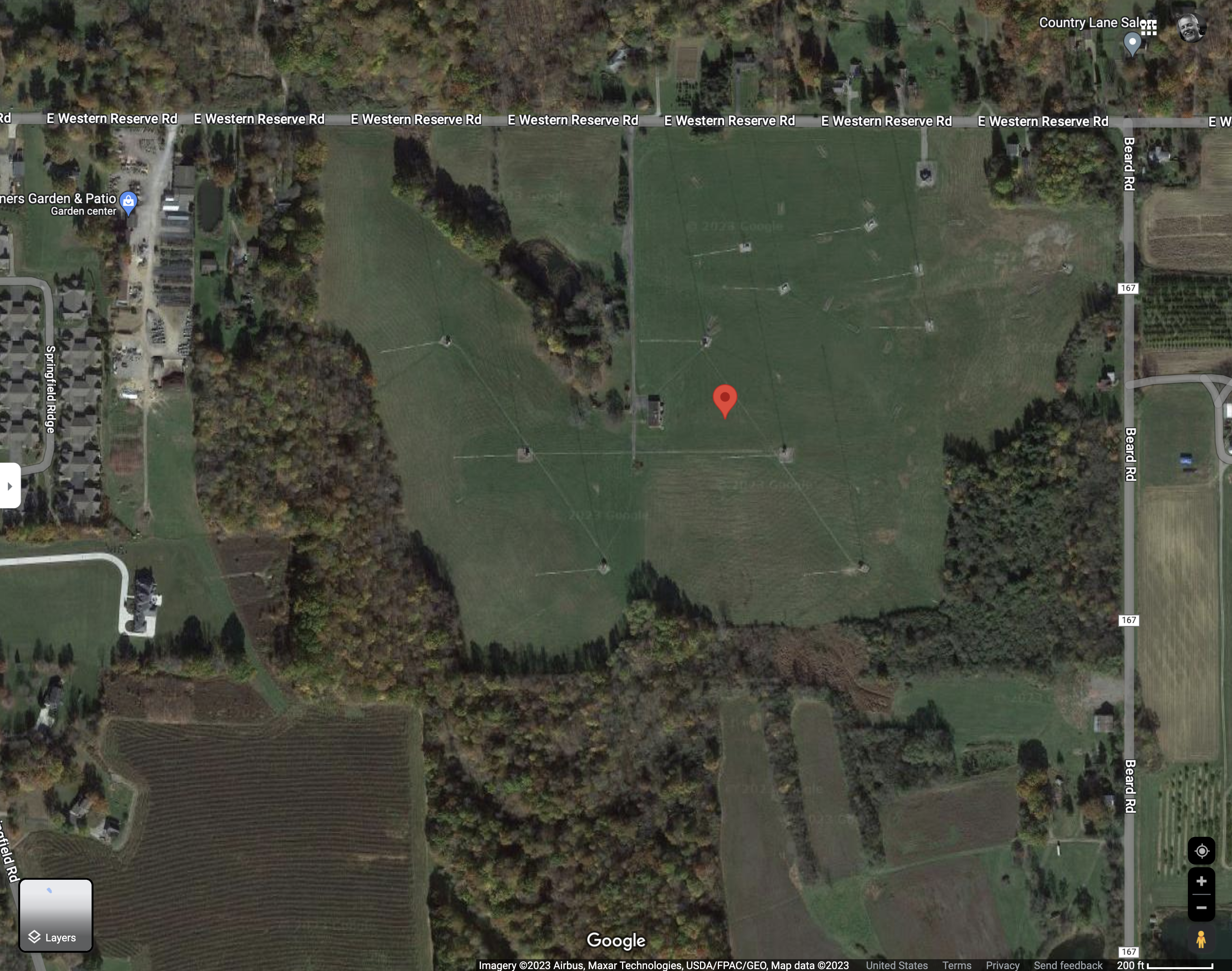
Of possible relevance is that WNIO and WKBN are non-directional by day, the former from a tower at another site in town. Also that WNIO was a 5kw DA-N from the site for most of its life and is now 9.5kw from the day site and 4.8kw from the night site we see in these images—and that its six towers have six different electrical lengths, ranging from 105.8° to 215.1°, apparently in slightly different positions on the ground. Also that WKBN has been 5kw day and night since the late 1940s.
We can also see from the Truscon ad that the original address of WFMJ was on Poland-Broadmans Road, which I think is now just Broad. (The current shack for WNIO is on East Western Reserve Road, while WKBN’s is at the end of a long driveway off that same road.) One can also see from above something of the entrance off broad and possibly something of the original footprint of the original tower layout.
So, some questions are:
1) Is the first photo from the entrance to the site in the Truscon ad?
2) When did WKBN show up, or was it already at this site?
3) Are the different lengths of towers in the current WNIO array the result of more efficient towers in it, and also why the 4.8kw signal roughly matches the old 5kw footprint on the ground?
4) In 1949, were six towers about the limit of what one could do with a directional array using long math, trig tables, and graph paper, and perhaps a record number for its time?
5) Was Truscon the outfit that pioneered narrow rather than fat towers, and ones with three sides rather than four?
There are other variables, of course. But I just enjoy this kind of detective work, which I share with broadcast engineers on one of the social media fora that I frequent. Which I’ve now done with the questions above.
Responses were both technical and nostalgic, which is how these things go.
Most notably, old pal Scott Fybush pointed to one of his transmitter visit reports and added this: “Summary: the current WNIO night site is not the original 1949 six-tower site. That was on what’s now Boardman-Poland Road (US 224) at what’s now the Shops at Boardman Park strip mall. It succumbed to development in the early 1990s, at which point 1390 moved to what’s now its current day tower. The current six-tower night array on Western Reserve Rd. was built in 2003, next to the 1977-vintage WKBN array. WKBN’s original DA was at the WKBN studios at 3930 Sunset, which is still the WKBN-TV facility.”
And I leave this here for history’s sake. Because all of AM radio is going down. It’s just a matter of time.