
A parking meter in Wheeling, West Virginia.
On our drive back to Indiana from New York last week, we stopped for dinner in Wheeling, West Virginia. This was the meter for the space where I parked across from Elle & Jack’s (which I recommend). It’s an old-fashioned mechanical meter, with slots for nickels, dimes, and quarters. All three were plugged. We took an outside table across from the space, where I asked the waitress what the parking hours were. “With all the construction downtown, it doesn’t matter,” she said. “You’re fine.” I suppose that meant the city wasn’t big on enforcement at the time.
But I was prepared to pay because I have a ParkMobile app, which I use here in Bloomington. With some experience at using the app, I’d like to make a couple of points about the shift of parking payment infrastructures from old to new.
First, it’s interesting that this parking meter is now just a sign for ParkMobile. The legacy design pattern had me fooled when I parked because it seemed to welcome coins before I discovered the slots were plugged. Also, the parking meters in Bloomington are a newer kind that are both mechanical and electronic: they accept quarters, while also displaying the ParkMobile zone. Since paying with coins costs less than using the ParkMobile app, we keep a cache of quarters in a little dashboard compartment for that purpose in our new used car (a 2017 VW Golf Alltrack, which I also recommend). But Wheeling made a good cost-saving choice by leaving the meters in place and putting a ParkMobile sign on them.
Second is that ParkMobile still has room to improve. A few weeks ago, I got a parking ticket during the two hours I bought from ParkMobile using the app. When I went to the city parking office to dispute the ticket, they told me the ticket was for my old New York license plate, which was still active on the app, but not the one I selected, which was for the current Indiana plate. ParkMobile should make it easier to delete an old plate and fix whatever went wrong after I selected the right one. I believe this is not an uncommon occurrence, because a conversation I half-overheard at the parking office suggested as much.
I have more thoughts about the transition of parking payment from legacy systems to apps on phones, but I’ll save those until I know more about the topic than I do now.

I wrote the following post in 2009. It holds up.
Toward Celebrating 8-11 Day
Mark Finnern has a great idea: Wikipedia papers. Specifically,
Every student that takes a class has to create or improve a Wikipedia page to the topic of the class. It shouldn’t be the only deliverable, but an important one.
The Wikimedia organization could help the professors with tools, that highlight the changes that a certain user has done on a page. You only pass, when the professor is satisfied with the scientific validity of the page. One could even mark the pages that went through this vetting process differently.
Instead of creating papers that end up in a drawer, you would create pages that you even feel ownership of and would make sure that they stay current and don’t get vandalized. You could even link to them on you LinkedIn profile.
It would make an enormous difference to the quality of Wikipedia year over year. One can think of wiki-how and other pages that could be improved using the same model.
There are other reasons. For example, Wikipedia has holes. Not all of these line up with classes being taught, but some might. Let’s take one example…
Wikipedia has an entry for 5-1-1, the phone number one calls in some U.S. states for road conditions. It also has an entry for 9-1-1, the number one calls in North America for emergency services. And, while it has an entry for 8-1-1, the “call before you dig” number in the U.S., it’s kinda stale. One paragraph:
All 811 services in the U.S. will end up using 611 by early 2007, as the United States Federal Communications Commission (FCC) in March 2005 made 811 the universal number for the 71 regional services that coordinate location services for underground public utilities in the U.S.[1][dated info] Currently, each of these “call before you dig” services, has its own 800 number, and the FCC and others want to make it as easy as possible for everyone planning an excavation to call first. This safety measure not only prevents damage that interrupts telecommunications, but also the cutting of electricity, water mains, and natural gas pipes. Establishment of an abbreviated dialing number for this purpose was required by the Pipeline Safety Improvement Act of 2002.
That last link takes you to one of those “Wikipedia does not have an article with this exact name” places. The “call before you dig” link redirects to Utility location. There you’ll find this paragraph:
One-call, Miss Utility, or Underground Service Alert are services that allow construction workers to contact utility companies, who will then denote where underground utilities are located via color-coding those locations. As required by law and assigned by the FCC, the 8-1-1 telephone number will soon be used for this purpose across the United States.
Well, it’s already being used. And it’s way freaking complicated, because there’s this very uneven overlap of entities — federal government, state goverenments, regional associations, and commercial entities, to name a few — that all have something to say.
For example, the U.S. Department of Transportation Pipeline and Hazardous Materials Safety Administration, or PHMSA. Right on their front page, they tell you April is Safe Digging Month. Good to know. April of what year? Next to a blurred emblem with an 811 over a shovel (a poor version the above, which comes from the Utility Notification Center of Colorado) and a horribly blurred graphic proclaiming WE SUPPORT SAFE DIGGING MONTH, a Call Before You Dig link leads to a page that explains,
Guidance for implementing safe and effective damage prevention for underground utilities was established by the Common Ground Alliance (CGA), a national organization representing all underground utility stakeholders. Calling before you dig is the first rule to remember when conducting underground related activities, no matter what the job is. The law requires you to phone the “One-Call” center at 8-1-1 at least two days prior to conducting any form of digging activity.
No link to the Common Ground Alliance. That org (a domain squatter has its .org URL, so it’s a .com) explains that it’s “a member-driven association dedicated to ensuring public safety, environmental protection, and the integrity of services by promoting effective damage prevention practices.” Its news page mentions that, among other things, August 11 is “8-11 Day”. It has a press release template in Word format. It also has news that “MGH Hired as CGA 811 Awareness Contractor” in .pdf. Within that one finds MGH’s website URL, where one finds that the agency is @mghus, which may be the hippest thing in this whole mess.
Digging further, one finds that there is a call811.com, which appears to be another face of the Common Ground Alliance. (If you’re interested, here are its “sponsors and ambassadors”.)
Also involved is the American Public Works Association. Apparently, the APWA is the outfit behind what LAonecall (one of the zillion of these with similar names) calls “the ULCC Uniform Color Code using the ANSI standard Z53.1 Safety Colors”. APWA must have published it at one point, but you won’t find it on its website. Hey, Google doesn’t. Though it does find lots of other sites that have it. Most are local or regional governmental entities. Or utilities like, say, Panhandle Energy. Here’s the graphic:

Here in New England (all of it other than Connecticut, anyway), the public face of this is Dig Safe System, Inc., which appears to be a nonprofit association, but there’s nothing on the site that says wtf it is — though it is informative in other respects. It does say, on its index page,
What is Dig Safe ®?
State laws require anyone who digs to notify utility companies before starting, and for good reason. Digging can be dangerous and costly without knowing where underground facilities are located.
Dig Safe ystem, Inc. is a communication network, assisting excavators, contractors and property owners in complying with state law by notifying the appropriate utilities before digging. Dig Safe®, a free service, notifies member companies of proposed excavation projects. In turn, these member utilities respond to the work area and identify the location of underground facilities. Callers are given a permit number as confirmation.
Member utilities, or contracted private locators, use paint, stakes or flags to identify the location of buried facilities. Color coding is used to identify the type of underground facilities… (and the same color coding as above)
I found out all of this — and much more — while I was researching for my column in the November issue of Linux Journal, which has Infrastructure the issue’s theme. I’m leveraging my leftovers here, closing one tab after another in my browser.
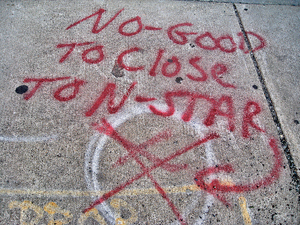
I’m also interested in approximately everything, one of which is the official-looking public graffiti on the ground all over the place. These are known locally as “dig safe markings”. At least that piece of the scattered one-call/call-before-you-dig/8-1-1 branding effort has taken root, at least here.
Anyway, I’d love to see a Wikipedia entry or two that pulls all this together. Maybe I should write it, but I’m busy. Hey, I’ve done this much already. Some actual experts ought to pick up the ball and post with it.
Which brings us back to Mark’s suggestion in the first place. Have a class do it.
Hey, @mghus, since you’re in Baltimore, how about suggesting a Wikipedia page project to The Civil & Environmental Engineering Department at UMBC?
Maybe for 8-11 Day?
[Update on 6 November 2023] Still no 8-11 Day, but the Wikipedia’s Utility Location article is pretty good now, covering various approaches around the world.
