
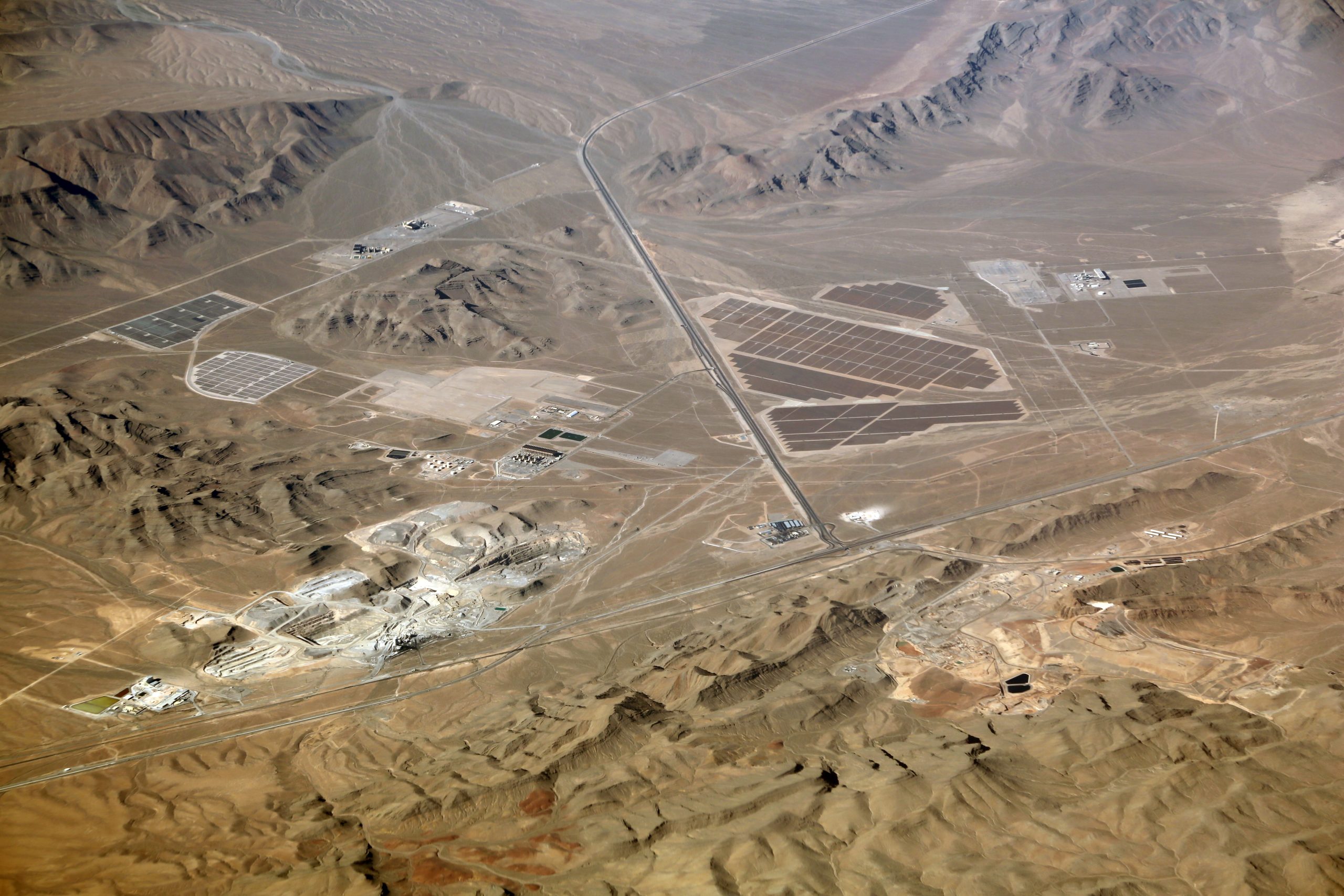
KXNT’s four-tower transmitter is in the center of this shot, across the Great Basin Highway to the left (southwest) of the solar farm, and northwest of I-15, which runs across the bottom of this shot, which I took while flying to Newark from Los Angeles in 2020. The area has been developed a lot since then. Solar panels cover much more land, and the Apex lime mining operation, on the left (southwest) side of this shot, is bigger and deeper than ever.
Short answer: it’s just the economics of AM radio in the Internet Age.
Long answer: that, plus… not sure.
Some history. Three years after KXNT went on the air in 1986 (as KVEG), it found a place from which it could transmit a big signal toward the Las Vegas metro from far out in the desert northeast of the city, but still inside its city of license: North Las Vegas. On maps, the location is still called Arrolime, after a lime quarry nearby. That operation’s today is Apex Lhoist, and it is both vast and deep.
AM stations need a lot of land to transmit, because their waves are long and their antennas are whole towers. Directional stations such as KXNT are especially demanding of acreage: four 293-foot towers arranged in a stretched-out parallelogram produce a highly directional signal that’s 50,000 watts by day and 25,000 watts by night. Both patterns look like dragonfly wings:
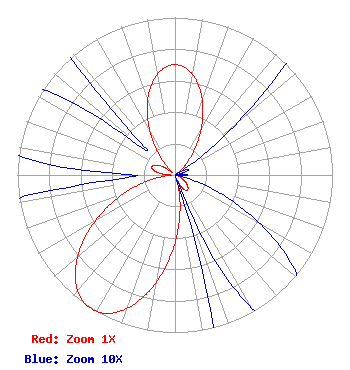
The bigger lobe is toward Las Vegas. The smaller lobe goes toward a lot of nowhere. Here is how Radio-Locator.com shows actual day and night coverage on the ground:
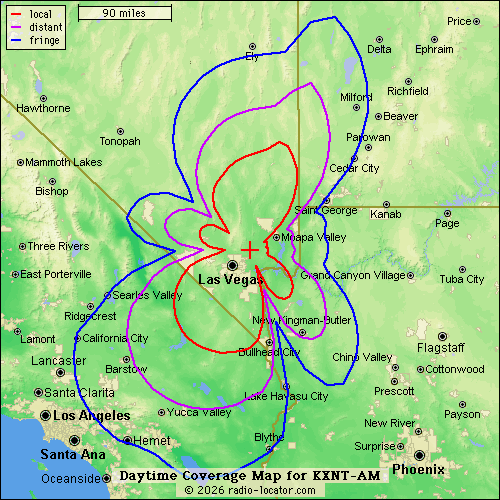
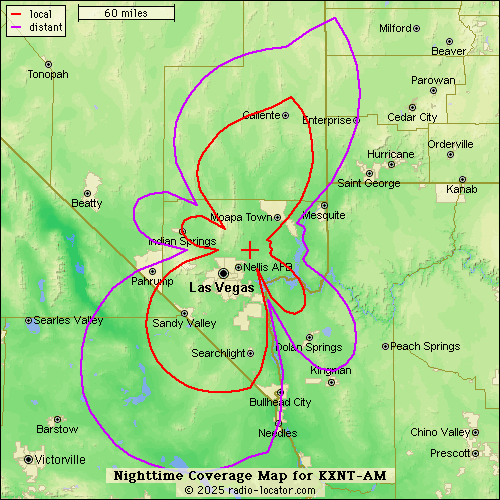
At night, however, AM signals bounce off the E layer of the ionosphere, which is why KXNT sounds pretty good after dark here in Santa Barbara, California. For now, anyway.
Here are the towers on Google Streetview:
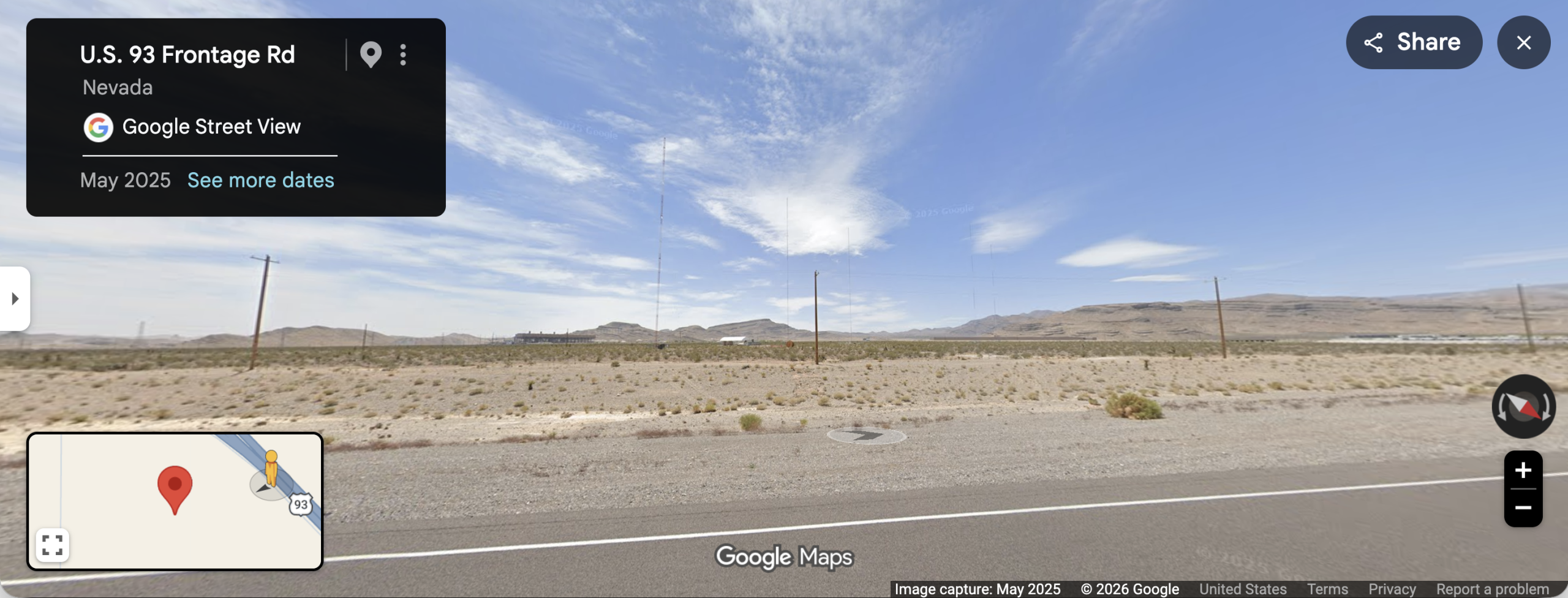
Look closely. They’re there.
These towers were safe for a long time. But broadcasting is giving way to newer industries now. According to the City of North Las Vegas, this region is now Apex Industrial Park: ~18,000 acres of desert being developed for:
- giant logistics centers
- manufacturing
- hydrogen production
- power generation
- data centers
- rail-served industry
- solar facilities
The city has spent tens of $millions on water, sewer, roads, and utilities, and it expects tens of thousands of jobs there over the next couple of decades.
It doesn’t mention an airport, though a new one just for moving freight would make sense, given everything else going on. (North Las Vegas Airport is deep inside Las Vegas’ northern sprawl, and neither of its runways vector in this direction.)
It also doesn’t mention mining, which is clearly active and expanding outward and downward. Possible reasons:
- The city is marketing developable land, not listing everything already there. It emphasizes new tenants and developers (Prologis, CapRock, Hopewell, Air Liquide, Kroger, Crocs, etc.) because those companies are developing new industrial sites.
- The Apex quarry has been there for most of a century. It’s legacy heavy industry, not part of the logistics boom, and not pretty unless you like quarries (which I do, but that’s me).
- The quarry is not using land for which the city is recruiting tenants. From an economic development perspective, it’s background infrastructure, like the railroad, the power plant, and the KXNT transmitter site.
- The city’s “Apex Companies” list features companies in the industrial park development program, not the neighborhood’s extant extractive industries. Air Liquide, warehouses, hydrogen plants, logistics parks, and data centers are all presented as examples of Apex’s new identity.
- North Las Vegas has spent years trying to rebrand Apex from a remote industrial nowhere into a park through which goods and bits are made and moved. Its pitch is clean energy, hydrogen, fulfillment, and high-tech manufacturing. A big open-pit quarry, while economically important, doesn’t serve that narrative.
And it’s the narrative that matters. The main characters in rural development stories these days are data and distribution centers: central features in the Internet of Bits and the Internet of Stuff. Next to that, broadcasting is old hat. AM especially.
KXNT’s owner is Audacy, which has been in dire financial straits for years. And this is hardly the first AM station it has shut down. KXNT is branded K-Dawn, a legacy of KDWN/720 when it was still on the air. Originally 50,000 watts and transmitting from a three-tower array on Galleria Drive in Henderson, KDWN was by far the biggest signal in town on either broadcast band. But Audacy sold that site in 2020 and moved the transmitter to a lesser facility in North Las Vegas, on acreage it shared with Audacy’s KXST/1140. Audacy folded both stations when it sold the land under the towers for $40 million in 2023.
I also just learned from a reader of this post that KXNT had been leasing the land, which was sold to Switch, a data center operator. This makes complete sense, because data centers need lots of power, and a vast solar farm is right across the street from the site.
If you go to Audacy KXNT website today, you’ll see it identifies as 101.5 FM. That FM signal is technically a “translator” with the callsign K268CS. It transmits with 250 watts from an ideal site for a signal that small: 1129 feet above the ground atop the landmark Strat Hotel on Las Vegas Boulevard. It’s a pretty cheap way to cover the metro and not much else. The FM signal can survive the demise of KXNT-AM, because it actually translates the HD-2 audio of sister station KXQQ/100.5. KXNT-AM was a separate stream, as I understand it, but both signals’ program streams are syndicated feeds from elsewhere, like much of radio today. Local radio with local programming is the exception more than the rule. (I wrote about one example here last week.)
Audacy is hardly alone in shutting down AM stations across the country. Cumulus, second of the “big three” station owners (iHeart is the third), just turned in the license of 560 AM in San Francisco, which had been KSFO for most of its century-long life. Clearly there were no takers, even though the signal covered the Bay Area very well. I read that writing on the wall more than a year ago:

One final thought.
While the airport story is plausible, I don’t see what airport, current or planned, they’re talking about. So I’m wondering if Audacy is just looking for an excuse to shut down yet another AM signal—especially one with a huge electric bill. (A 50,000-watt transmitter sucks more than that off the grid.) That would make sense on its own.