
Short answer: It’s just the economics of AM radio in the Internet Age.
Long answer: A new data center is going there.
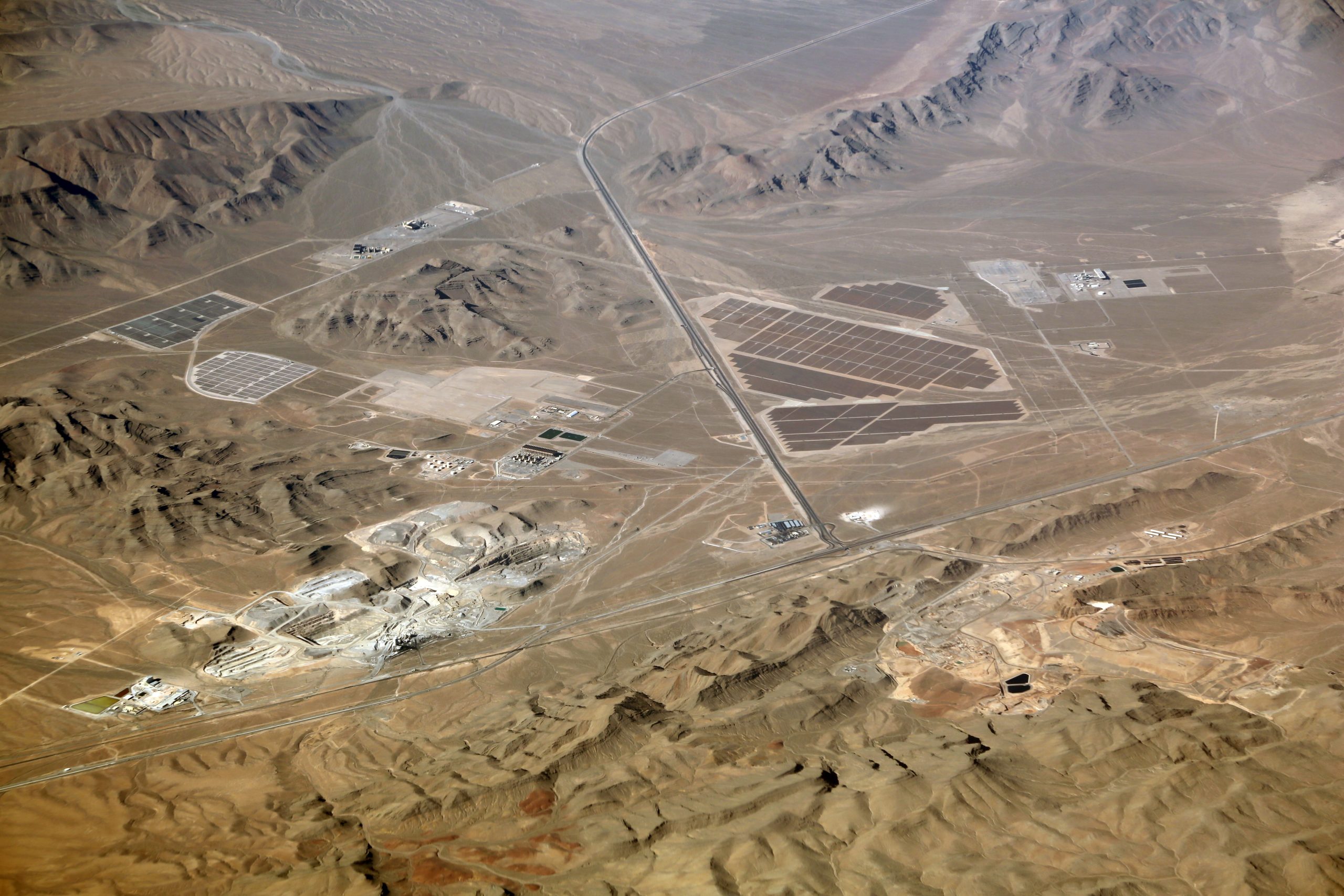
Some history. Three years after KXNT went on the air in 1986 (as KVEG), it found a place from which it could transmit a big signal toward the Las Vegas metro from far out in the desert northeast of the city, but still inside its city of license: North Las Vegas. On maps, the location is still called Arrolime, after a lime quarry nearby. The mine operation’s today is Apex Lhoist, and it is both vast and deep.
AM stations need a lot of land to transmit, because their waves are long, their antennas are whole towers, and their ground systems can be twice as wide as the towers are high. Directional stations such as KXNT are especially demanding of acreage: its four 293-foot towers are arranged in a stretched-out parallelogram to produce a highly directional signal that’s 50,000 watts by day and 25,000 watts by night. Both patterns look like dragonfly wings:
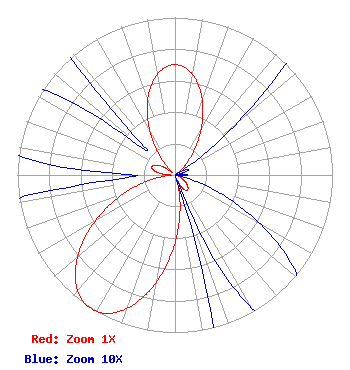
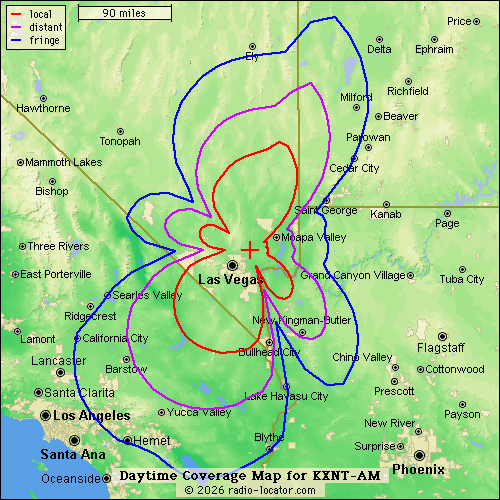
The bigger lobe is toward Las Vegas. The smaller lobe goes toward a lot of nowhere. Here is how Radio-Locator.com shows actual day and night coverage on the ground:
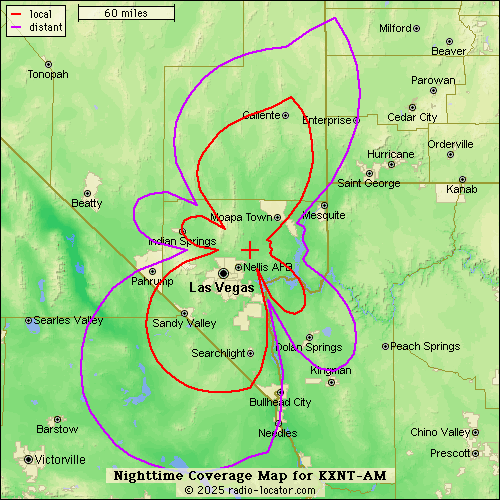
At night, AM signals bounce off the E layer of the ionosphere, which is why KXNT sounds pretty good after dark here in Santa Barbara, California. While it still can.
Here are the towers on Google Streetview:
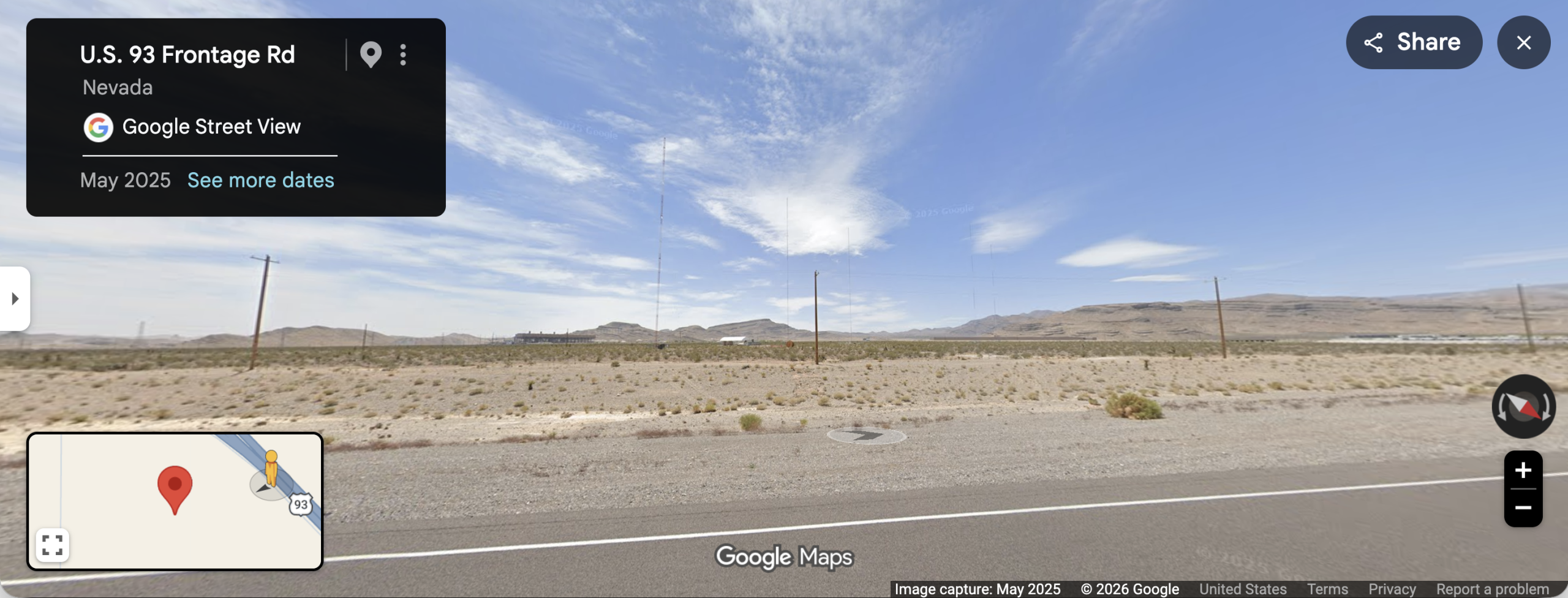
These towers were safe for a long time. But broadcasting is giving way to newer industries now. According to the City of North Las Vegas, this desert landscape is now Apex Industrial Park: ~18,000 acres being developed for:
- giant logistics centers
- manufacturing
- hydrogen production
- power generation
- data centers
- rail-served industry
- solar facilities
The city has spent tens of millions of dollars on water, sewer, roads, and utilities, and it expects tens of thousands of jobs to come over the next couple of decades.
The city doesn’t mention an airport, though a new one just for moving freight would make sense, given everything else going on. (North Las Vegas Airport is deep inside Las Vegas’ northern sprawl, and neither of its runways vector in this direction.)
The city also doesn’t mention mining, which is clearly active and expanding outward and downward. Possible reasons:
- The city is marketing developable land, not listing everything already there. It emphasizes new tenants and developers (Prologis, CapRock, Hopewell, Air Liquide, Kroger, Crocs, etc.) because those companies are developing new industrial sites.
- The Apex quarry has been there for most of a century. It’s legacy heavy industry, not part of the logistics boom, and not pretty unless you like quarries (which I do, but that’s me).
- The quarry is not using land for which the city is recruiting tenants. From an economic development perspective, it’s background infrastructure, like the railroad, the power plant, and the KXNT transmitter site.
- The city’s “Apex Companies” list features companies in the industrial park development program, not the neighborhood’s extant extractive industries. Air Liquide, warehouses, hydrogen plants, logistics parks, and data centers are all presented as examples of Apex’s new identity.
- North Las Vegas has spent years trying to rebrand Apex from a remote industrial nowhere into a park through which goods and bits are made and moved. Its pitch is clean energy, hydrogen, fulfillment, and high-tech manufacturing. A big open-pit quarry, while economically important, doesn’t serve that narrative.
And it’s the narrative that matters. The main characters in rural development stories these days are data and distribution centers: central features in the Internet of Bits and the Internet of Stuff. Next to that, broadcasting is old hat. AM especially.
KXNT’s owner is Audacy, which has been in dire financial straits for years. And this is hardly the first AM station it has shut down. Earlier it turned off KDWN/720 (K-Dawn) and KXNT1140. KDWN for many years was the biggest signal in town, transmitting with 50,000 watts from a three-tower array on Galleria Drive in Henderson. Audacy sold that site in 2020 and moved the KDWN transmitter to a lesser facility in North Las Vegas, on acreage it shared with KXST. Both stations went away when the land under their towers sold for $40 million in 2023. There’s an acronym for all these moves: NIS, for Reduction In Stations.
Here is the interesting part: A reader just told me that the land under KXNT’s transmitter, which Audacy had been leasing, has been sold to Switch, which brags about “Building the Most Responsible Data Centers.”
The location makes complete sense, because data centers need lots of power, and there is a vast solar farm is right across the street from the site. (That farm is now much bigger than what you see in the photo above.) Also, because Nevada. They like this kind of stuff there.
Back to radio.
When an AM signal goes away, it sometimes persists or re-appears on the FM band, often through a translator of a co-owned station’s HD subchannel onto a standalone transmitter of its own. This can get complicated.
About KXNT, this story says, “The station’s programming will be combined with that of its sister stations, 101.5 KDWN/94.1 KMXB-HD3 FM.” I believe this means,
- The station called K-Dawn on 101.5 FM, had been the FM translator of the late KDWN/720. It is now and will remain
- K268CS, which re-transmits the HD3 signal of
- KXMB/94.1, and
- some of what had been on KXNT/840 will persist on 101.5 FM and 94.1 HD3.
As translators go, K238CS is pretty good. It transmits with 250 watts from an ideal site for a signal that small: 1129 feet above the ground atop the landmark Strat Hotel on Las Vegas Boulevard. It’s a pretty cheap way to cover the metro and not much else. But don’t be surprised if more signals and streams disappear from Audacy lineup of (link-less) brands for Las Vegas.
Audacy is hardly alone in shutting down AM stations across the country. Cumulus, second of the “big three” station owners (iHeart is the third), just turned in the license of 560 AM in San Francisco, which had been KSFO for most of its century-long life. Clearly there were no takers, even though the signal covered the Bay Area very well. I saw that writing on the wall more than a year ago:

I also heard, since I wrote this, that it would have cost $70k for Audacy to relocate KXNT’s transmitter to a single tower inside Las Vegas, using much less power. They opted not to follow that route, even though it would still cover the metro. I also heard that Cumulus really did shop the 560 San Francisco license around and had no takers. That‘s how little an AM license is worth on the open market today.
As I understand it, most of the programming on KXNT and K-Dawn is syndiated stuff from elsewhere. This is true for most of radio in the US today. Much of what you hear is “brokered,” meaning given to stations for free, with the sources getting paid for advertsing all over the place, and gaps left open in the streams for stations to fill with their own advertising.
Local radio with local programming is now the exception more than the rule. (I wrote about one example here last week.)
What I’m really curious about now is The Core datacenter complex, which is in Southwest Las Vegas. Switch says it features all these virtues (copied and pasted from that webpage and the video there):
- Up to 495 MW of power upon completion
- Up to 3.9 million gross sq ft
- Over one mile of power spines at the control campus
- 24/7/365 elite mission control centers, military-grade security, and company-employed fire brigades
- The highest-rated and most cost-effective colocation environment in the industry
- 100% renewable energy enabling industry-leading ESG compliance
- Up to 2MW per cabinet
- 100% power uptime guarantee
- 2% sales and use tax in Nevada
- 75% reduction in personal property tax in Nevada (noting that there is no personal state income tax in NV)
- Covers southwestern latency zone
- 5ms to Los Angeles
- Dedicated 7ms fiber to The CITADEL via the Switch SUPERLOOP®
- Save up to 35-60% on connectivity savings through a telecom audit
- The world’s most powerful telecom purchasing cooperative
That’s all Core.
As for Switch, Data Center Dynamics reported in December that the company was due to be bought by Softbank for $4 billion.
Reporting around the closure says Audacy leased the site and the landowner is selling it. So this isn’t simply Audacy deciding that 840 AM isn’t worth operating, though I’d bet that if Audacy owned the land, 840 AM would go the way of 720 and 1140 AM.
Meanwhile, some diggings:
- Las Vegas Review Journal reported in January that Switch bought 176 acres along US 93 at Apex for $85.5m. It also said, “Its new land holdings northeast of Las Vegas are along U.S. Highway 93, about 5 miles from the interchange with Interstate 15.” This sounds farther away from I-15 than the KXNT site.
- More context: “Switch’s land purchase follows its announcement last fall that it raised nearly $659 million through a bond sale to fund its growth strategy, including ongoing development at its data-center sites locally and around the country. It also unveiled last summer that it had borrowed $20 billion since the prior year to support the growth of its campuses, reduce its cost of capital, and fully retire the bank debt incurred in the buyout that took the company private in 2022.” And it’s going to Softbank for $4 billion? There is more to the financial story here.
- Data Center Dynamics said in March that says Switch bought “another 140 acres at Apex Industrial Park, northeast of Las Vegas, adjacent to Highway 93.” That I’ll bet is, or includes, the KXNT site
When the Review-Journal reported on Switch’s first Apex acquisition in January, North Las Vegas said Switch had not yet filed development plans for the property, and Switch itself declined to say what it intended to build there. Given Switch’s business, and across-the-street proximity to a vast solar farm, we can guess.
What we are seeing in this transition, one way or another, is a spread of desert occupied by four towers carrying 50,000 watts of analog information through electromagnetic fields being replaced by vast rectangular buildings full of machines processing and routing digital information to the world through fiber, and consuming some orders of magnitude more power than any radio station. But all-green, they say. I guess we’ll see.

Leave a Reply