
For a few decades in the last century, some of the most influential radio heard in the United States came from Mexico, where transmitter powers were essentially unlimited. (In the US and Canada, the maximum permitted power was 50,000 watts—abbreviated 50 kW, for kilowatts—with the brief exception of WLW/700 in Cincinnati, which was 500 kW from 1934 to 1939.)
Also, at night the F layer of the Ionosphere becomes a mirror for AM radio waves. These reflected skywaves allow a strong station to cover regions up to hundreds or even thousands of miles away. If you’re ever in Hawaii, tune in 1070 AM at night to hear KNX from Los Angeles. (Though a bit less punchy, you can get KFI/640 too.)
In the US, a few dozen stations were privileged to operate on clear channels, free from interference by other stations either across large parts of the country, or across the whole continent. Some “clears” were also assigned to Mexico and Canada. The big difference was that Mexico allows powers above 50 kW. The biggest Mexican stations aiming to serve the US at night became known as border blasters, and their influence lasted from the 1930s into the 1980s.
Wikipedia has information on many of these (at the last link and in the table below), but the data is scattered and sometimes mixes three different listings of power:
- The power a station was, and might still be, authorized to use
- The power its transmitter was, and might still be, able to produce
- The much higher powers often claimed by station promotions
It also mixes two somewhat different generations of border radio: the flamboyant “outlaw” blasters of the 1930s and the more conventional postwar blasters that sold blocks of airtime to American programmers, some of which was devoted to rock & roll.
Here is my best shot at a list of the most important stations, where their transmitters were, how much power they credibly had, and how long their peak border-blasting periods lasted. I unpack details about each in the sections that follow.
| Station | Channel | Transmitter location | Highest credible power | Peak border-blaster period |
|---|---|---|---|---|
| XERA | 840, 800 kHz | Villa Acuña, Coahuila, now Ciudad Acuña, opposite Del Rio, Texas | 500 kW; claimed an effective 1 MW | 1935–1939 |
| XERF | 1570 kHz | Ciudad Acuña, Coahuila | 250 kW installed, though probably not sustained | Early 1950s–early 1970s |
| XENT | 1110/1115 kHz | Nuevo Laredo, Tamaulipas, opposite Laredo, Texas | 150 kW authorized; probably 75–100 kW in actual use | 1933–1940 |
| XELO, later XEROK | 800 kHz | Ciudad Juárez, Chihuahua; originally Piedras Negras | 150 kW at night | 1941–late 1970s |
| XEG | 1050 kHz | Monterrey, Nuevo León | 150 kW historically; later generally 100 kW | About 1950–early 1980s |
| XEAW | Various frequencies | Reynosa, Tamaulipas, opposite McAllen, Texas | About 100 kW | Mid-1930s–1941 |
| XERB, later XEPRS | 730 kHz originally; 1090 after 1941 | Tijuana/Rosarito, Baja California | 150 kW early; 50 kW during the Wolfman Jack years | 1936–1941 and 1966–1971 |
| XEAK, later XETRA, now XEWW | 690 kHz | Tijuana initially; later Rosarito | 50 kW | 1957–about 1970 |
| XED | Around 960 kHz | Reynosa, Tamaulipas | 10 kW | 1930–about 1933 |
| XER | 735/840 kHz | Villa Acuña, Coahuila | Began at 50 kW; later approximately 150 kW | August 1932–February 1933 |
The champion: XERA
The largest of them all was XERA, built by the notorious “goat-gland doctor” John R. Brinkley at Villa Acuña, now Ciudad Acuña, across the Rio Grande from Del Rio, Texas.
Sources seem to confirm that the claimed power of 500 kW was for real. The station claimed that its directional antenna system produced the equivalent of one million watts in its signal toward the US.
XERA called itself “the world’s most powerful broadcasting station,” although stations elsewhere in the world have operated with much higher powers. (Today Kossuth Rádió‘s Transmitter Solt in Hungary is 2,000,000 watts—2 megawatts—on 540 kHz.)
XERA operated at its peak from 1935 until the end of 1939. After Mexico ratified the North American Regional Broadcasting Agreement (NARBA), the station was reduced to about 180 kW. The Mexican government eventually closed it, dismantled the transmitter, and moved the equipment to Mexico City.
If you care about this stuff, dig John Schneider’s history of XER and XERA. Also—
XERF: the most legendary border blaster
The best-known postwar border blaster was XERF, also in Ciudad Acuña. XERF went on the air in 1947 with a 50-kW transmitter. By the early 1950s it was using a 250-kW RCA Ampliphase transmitter—state of the art for its time.
Some broadcast-engineering accounts suggest that the transmitter was unreliable and may never have operated continuously at its full 250 kW rating. Still, that was the rated plant, and XERF’s signal covered an enormous part of North America.
Country-music disc jockey Paul Kallinger became nationally known from XERF as “Your Good Neighbor Along the Way.” The station carried country music, gospel, preachers, mail-order pitches, patent remedies and many other specious products sold pushe across border radio.
It was also where Bob Smith developed his Wolfman Jack character. According to the Handbook of Texas account of XERF, Wolfman Jack worked there for about six months in 1963. From XERF he introduced many American listeners to R&B and other forms of music that most domestic stations would not play.
XERF remained under private ownership until 1986, when it passed to Mexico’s Instituto Mexicano de la Radio. It still broadcasts from Ciudad Acuña as La Poderosa, at a listed 100 kW.
XENT: Weaker than claimed
XENT in Nuevo Laredo was operated by Norman Baker, an inventor, broadcaster, and, well, con man.
XENT ran from 1933 until Mexican authorities forced it off the air in 1940. It was known as the “Calliaphone Station,” after the air-powered calliophone Baker had invented. By the way, XENT succeeded KTNT (Know The Naked Truth), a radio station Baker operated in Muscatine, Iowa from 1925 to 1931.
Contemporary listings gave XENT a power of 150 kW. But a surviving promotional card says it was “licensed for 150,000 watts” when it was actually pushing out between 10,000 and 75,000 watts. Other accounts place its actual output between 75 and 100 kW. (Some perspective: signal strength increases as the square root of transmitted power.) So a 500 kW signal is actually a little over 3 times the strength of a 50 kW signal.
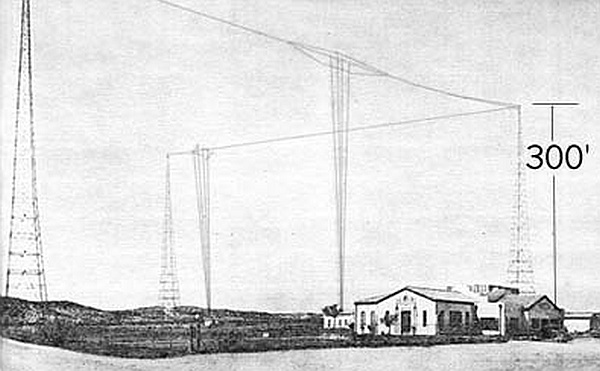
Anyway, XENT was authorized for 150 kW but probably never sustained at that level. A surviving XENT station card even gives details about its two 300-foot towers, spaced 650 feet apart.
XEPN /XELO / XEROK: X-Rock 80 for El Paso and the Southwest
The station that eventually became XEROK, best known in its prime as X-Rock 80, began in Piedras Negras with the callsign XEPN and then XELO. It moved to Ciudad Juárez around 1941 and settled on 800 kHz, one of the clear channels allocated to Mexico.
A custom-built 150-kW transmitter gave XELO an immense nighttime signal. Spanish programming served Juárez and El Paso during the day, while much of the nighttime schedule was sold to American preachers, pitchmen, and mail-order advertisers.
The station became XEROK in the 1970s and later adopted English-language Top 40 as X-Rock 80. It was still authorized for 150 kW, though in later years it generally operated at 50 kW or less.
Though still licensed, the station has been silent since 2022, when its transmitter was dismantled. While the tower is now gone, Google StreetView shows it standing when the site was last photographed in 2021.
XEG: from deeper in Mexico
XEG broadcast on 1050 AM from Monterrey, in the state of Nuevo León, well south of the Rio Grande. But its north-aiming 150 kW nighttime signal and programming for American audiences made it a solid border blaster.
American airtime was largely sold through Harold Schwartz’s Chicago operation beginning around 1950. In its prime, XEG became an important outlet for country music, gospel, preachers, R&B and mail-order advertising.
At night, from the late 1960s into the early 1980s, XEG carried recorded by KGFJ (now KYPA/1240) in Los Angeles, at the time when KGFJ was a cultural landmark in Los Angeles’ Black community. Wolfman Jack also bought time on XEG after becoming established on XERF and XERB.
XEG is one of only two border blasters I ever heard from my homes in New Jersey and New York, and then only when the New York station on 1050 AM (WMGM, then WHN) went off the air on Sunday nights for transmitter maintenance. It boomed in. What I remember best is the musical group Don and Earl, and the evangelist Billy James Hargis (who was later parodied by Don Imus as “The Reverend Billy Saul Hargis” of the 1st Church of the Gooey Death and Discount House of Worship).
XEG is still operating, now at a reported 100 kW, and with just one tower, making it non-directional. But its classic American-facing period lasted approximately three decades.
XERB: Wolfman for Socal
XERB is a complicated case because it had a number of high points, and remains a powerhouse signal on the AM band in Southern California
The station started on 730 kHz in 1939 with 150 kW. Under the NARBA agreement, it moved to 1090 kHz in 1941 and dropped to 50 kW. But the transmitter sits in Rosarita Beach, just south of Tijuana. This gives it a strong signal along the whole south coast of California, day and night. It uses three 178° (just under half-wave) towers to produce a narrow figure-8 pattern that exactly matches the California and Baja California coasts.
Wolfman Jack took control of much of XERB’s programming in 1966. His shows were recorded in Los Angeles and transported to the Mexican transmitter. By 1971 he was reportedly making nearly $50,000 a month from the operation.
The arrangement collapsed after the station’s Mexican owners and government regulators squeezed Wolfman out. Nevertheless, XERB’s 1966–71 period became the border-radio experience remembered by a generation of West Coast listeners—and later evoked in American Graffiti, on which Wolfman played himself.
The station subsequently became XEPRS, had a number of English-language formats, most notably as a San Diego-based sports station. (It has returned to Spanish programming.)
XEAC / XEAK / XETRA / XEWW: the Mighty 690
XEAC was born in 1934 in Tijuana, transmitting on 820 or 815 kHz. In 1938 it moved to 980 AM. 1957 it was upgraded to 50 kW and relaunched as “The Mighty 690,” playing Top 40 music for Southern California on 690 AM. (An advantage for both XERB and XETRA was that there were no high-powered top 40 stations with large signal footprints in Los Angeles and San Diego.)
Gordon McLendon took over its American programming operation in 1961, moved the transmitter closer to the coast at Rosarito (near XERB) and changed the calls to XETRA, pronounced “X-TRA.”
XETRA then launched an all-news format aimed at Los Angeles. The station called itself “the world’s first and only all-news radio station” and identified as a Los Angeles station rather than a Mexican one.
The Museum of Broadcast Communications calls XETRA the first commercially successful all-news operation in North America. In 1966, it boasted a staff of 50.
After KFWB/980 in Los Angeles went all-news, XETRA dropped the format and wandered through other formats in the followint years. Today the callsign is XEWW, but the transmitter and site are the same. By day it is also 77 kW, meaning it still blasts into Socal. The current format is Spanish talk.
XED: the original
XED was sited in Reynosa, on the south side of the Rio Grande west of Corpus Christi, and was the first true Mexican border blaster.
It began in 1930 with 10 kW, which was then the most powerful transmitter in Mexico. Its programs and advertising were aimed across the river at the United States.
Among other claims to notoriety, XED promoted the Tamaulipas state lottery to American listeners, bringing its operators into conflict with United States laws against interstate lottery promotion.
Jimmie Rodgers reportedly appeared somewhere in the station’s inaugural programming. XED also demonstrated the basic business model that later stations followed: put the transmitter in Mexico, maintain studios or sales operations in the United States, and use a powerful signal to reach an audience that American stations could not or would not serve.
Sources and further reading
The indispensable book is Gene Fowler and Bill Crawford’s Border Radio: Quacks, Yodelers, Pitchmen, Psychics, and Other Amazing Broadcasters of the American Airwaves.
The University of Texas at Austin holds the underlying Border Radio Collection, including papers, recordings, photographs, and station promotional material.
Useful online accounts include:
Leave a Reply