
Few memories are more vivid to me than trying to sleep as a kid in the back of our Ford station wagon while our parents took turns driving all night from New Jersey to North Carolina. I would look out the window at the passing power lines rising up at the poles and down again on the sag, while Martin Denny’s Quiet Village played on the radio. The announcer, in his all-night basso AM radio voice, said the station was “Double You Bee Tee,” like the callsign was important.
And it was. WBT was one of the country’s biggest radio stations, with a night signal shaped to match the East Coast, sounding strong from Newfoundland to Cuba. A few months back, I listened to it on a small portable radio in a Brooklyn basement AirBnB.
But these days WBT’s signal is just a placeholder, broadcasting music interrupted by announcements that its programming is now only on FM. The historic transmitter site, with its three iconic towers, is for sale. Here is how they looked to me while flying out of CLT in 1986:
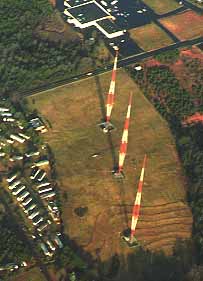
They were ruined by Hurricane Hugo three years later, and rebuilt, both because they were iconic landmarks and because AM radio was still a money-maker.
That’s over now. What’s not over is the urge to preserve Blaw-Knox “diamond” towers: ones that are wide in the middle and pointed at the ends. Designed and built in the 1930s, they are contemporaneous with, if not exemplary of, the art deco movement.
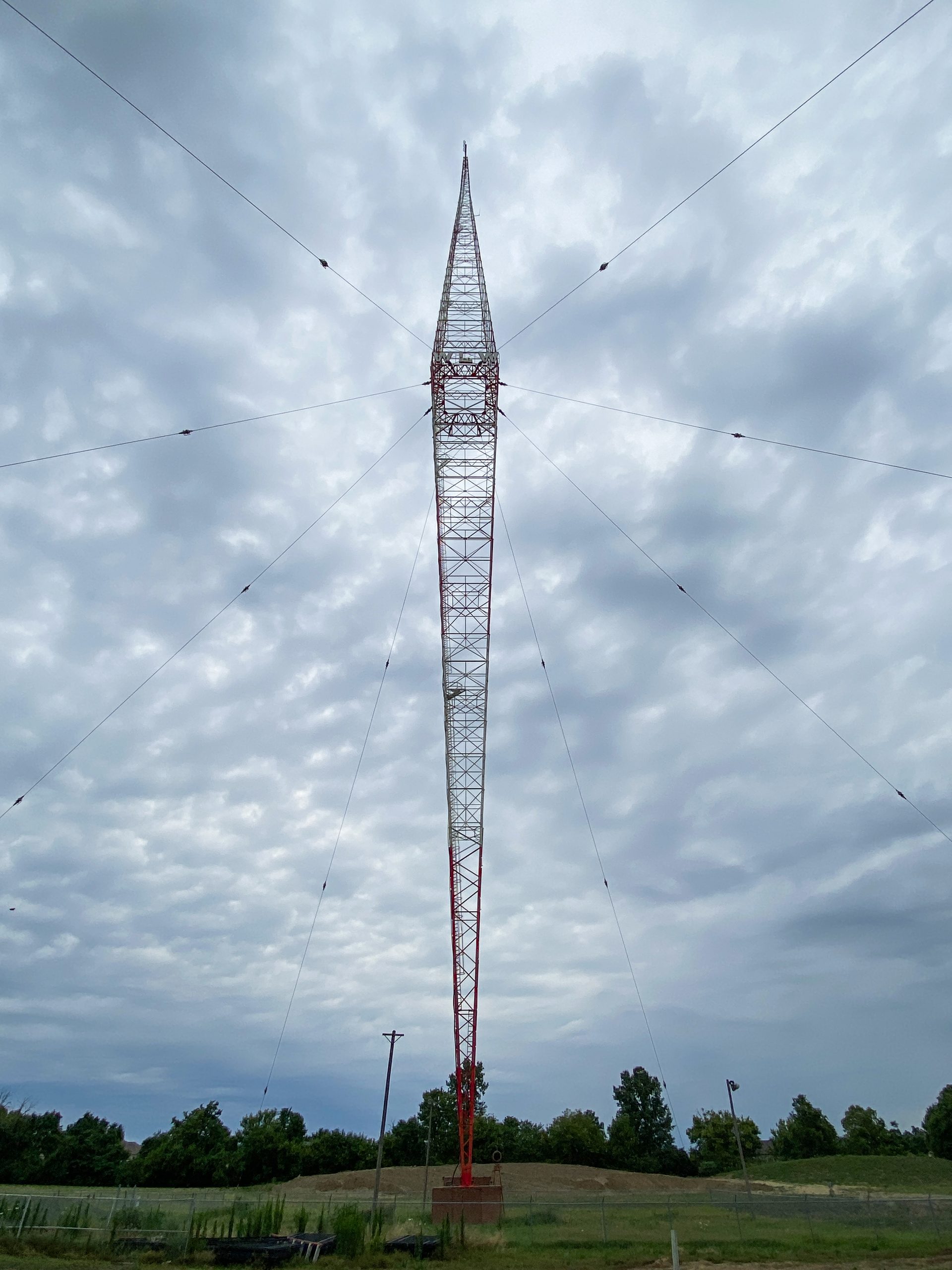
Tallest of the survivors is the Lakihegyi tower in Hungary. It is also preserved. The famous ones in the US transmit the signals of WSM/650 in Nashville, WLW/700 in Cincinnati, as well as WBT’s in Charlotte. WSM and WLW are both functioning stations, and their towers are too iconic to lose.
Efforts to preserve WBT’s towers are in the works. See here. But it’s a long shot. The owners have made clear that the signal has no economic value. The towers will need to be maintained (preservation isn’t cheap), and have no use other than standing as landmarks. Even if only one of them stands, the cost is still there.
Others Blaw-Knox diamond towers still standing are WBNS/1460 in Columbus, Ohio, and WFEA/1370 in Manchester, New Hamphire. My guess is that neither will outlive their licenses.
Leave a Reply